Panasonic 樂聲牌 has long been a popular induction cooker choice in the market thanks to its brand reputation and product quality. We will take an in-depth look at every aspect of Panasonic 樂聲牌 induction cookers, including brand background, product design, functional features, durability, repair and maintenance, while also gathering user reviews and Consumer Council reports from Hong Kong, Mainland China, Taiwan, Japan, Europe and the United States, to provide you with a comprehensive buying reference.
<[TOC]/p>
Panasonic 樂聲牌 Brand Overview
Panasonic(樂聲牌, formerly Matsushita Electric)is a multinational electronics manufacturer originating from Japan. Founded in 1918, it has a history of more than a century. In its early days, the brand started by producing light bulb sockets, and later gradually expanded into various fields such as home appliances, audio-visual equipment, digital products and even industrial solutions. Panasonic is renowned worldwide for its advanced technology, reliable quality and user-friendly design, and has built a strong reputation among consumers globally.
In the Hong Kong market, Panasonic 樂聲牌 home appliances, such as air conditioners, refrigerators, washing machines, microwave ovens and rice cookers, have long been deeply rooted in local households and become a well-known brand. Its induction cooker products also inherit the brand’s fine tradition, focusing on technological innovation and user experience, and are committed to providing Hong Kong families with safe, efficient and convenient cooking solutions.
Basic Principles and Advantages of Induction Cookers
Before going into a detailed review of Panasonic induction cookers, let us briefly understand how induction cookers work and their advantages compared with traditional gas hobs.
Induction cookers use the principle of electromagnetic induction for heating. When current passes through the coil beneath the hob surface, it generates a high-frequency magnetic field. When the magnetic field penetrates the base of magnetic cookware, eddy currents are produced in the pot base, causing the cookware itself to heat up rapidly and thereby heat the food inside. This process is highly thermally efficient because the cookware heats up directly, rather than the hob surface heating first and then transferring heat to the cookware.
The main advantages of induction cookers include:
- Fast heating and high thermal efficiency: Heat is generated directly at the pot base, reducing heat loss. Food boils faster than with traditional gas hobs and ceramic hobs, saving energy.
- Precise temperature control: Multi-level power adjustment allows accurate control of cooking temperature, making it suitable for the cooking needs of different dishes.
- High safety: There is no open flame, and the hob surface itself does not become extremely hot (only residual heat remains), reducing the risk of burns and fire. Many models are equipped with safety features such as child safety locks, cookware detection and overheating protection.
- Easy cleaning: The hob surface is smooth, usually made of glass or ceramic panels, which are less likely to trap dirt and grease. After cooking, a simple wipe is usually enough.
- Energy-saving and environmentally friendly: High thermal efficiency means less energy waste. The absence of an open flame also means no exhaust gases are produced, keeping the kitchen air fresher.
- Better kitchen aesthetics: The design is stylish and simple, while built-in models can integrate seamlessly with kitchen cabinets, enhancing the overall look of the kitchen.
Detailed Review of Panasonic 樂聲牌 Induction Cookers
Panasonic 樂聲牌 has launched a variety of induction cookers in the Hong Kong market, including single-zone, double-zone, built-in and freestanding models, to meet the needs of different households. Below is a detailed review from multiple perspectives.
Core Technology and Heating Performance
Panasonic induction cookers use its well-regarded IH (Induction Heating) technology. Some higher-end models are also equipped with an advanced infrared sensor (IR Sensor), which can directly detect the temperature of the pot base for more precise temperature control, helping to prevent oil from overheating or food from burning. ECONAVI energy-saving technology is also a highlight of some products. It can automatically detect cookware size and ingredient quantity, adjust output power and achieve energy savings.
- Power output: Panasonic induction cookers usually offer multiple power levels, covering everything from low-power keep-warm settings to high-power rapid heating, such as the Boost function. Generally speaking, maximum power can reach 2800W or above (depending on the model and Hong Kong electrical specifications), meeting the needs of Chinese-style stir-frying.
- Heating evenness: Users generally report that heating is relatively even, especially when using flat-bottomed cookware. However, as with all induction cookers, the material and flatness of the cookware base have a direct impact on heating evenness.
- Temperature-control accuracy: Models equipped with an infrared sensor perform well in temperature control, particularly for fried dishes that require precise oil temperature control or dishes that need constant-temperature stewing. Even entry-level models without an infrared sensor can provide relatively stable temperature control through stepped power adjustment.
Design and Appearance
Panasonic induction cookers tend to have a simple and stylish design, with an emphasis on blending into modern kitchen styles.
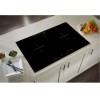
- Panel material: Most models use SCHOTT CERAN®, a reputable German brand, or Japanese NEG tempered glass panels. These are attractive, durable, heat-resistant, relatively scratch-resistant and easy to clean.
- Control interface: Most use touch-button designs and are intuitive to operate. Some models are equipped with LED displays that clearly show information such as power level and timer settings. Higher-end models may have more refined slide-style power controls.
- Built-in and freestanding models:
- Built-in: These can integrate perfectly with kitchen cabinets, making the kitchen look neater and more attractive. Panasonic offers built-in models in various sizes to suit kitchens of different sizes. During installation, attention must be paid to cut-out dimensions and ventilation space.
- Freestanding/Portable: These are highly flexible, require no fixed installation and can be used simply by plugging in. They are suitable for renters or households with limited kitchen space. Panasonic freestanding induction cookers are usually compact in design, making them easy to move and store.
- Colours and details: The mainstream colour is black, while some models may feature silver or white frame accents.
Functional Features
Panasonic induction cookers are usually equipped with various practical functions that enhance the cooking experience and safety.
- Safety functions:
- Child safety lock: Prevents children from accidentally starting the appliance or changing settings.
- Cookware detection: If there is no cookware or the cookware is unsuitable, the induction cooker will not start or will automatically stop heating.
- Overheating protection: When the hob surface or internal temperature is too high, the appliance automatically cuts power to prevent accidents.
- Residual-heat warning: When the hob surface still has residual heat after being switched off, a warning light will illuminate to remind users not to touch it.
- Small-object detection: Prevents small metal items such as knives and forks placed on the hob surface from being heated.
- Auto shut-off: If there is no operation for a long time, or if the user forgets to switch off the appliance after cooking, the induction cooker will automatically turn off.
- Cooking modes:
- Preset cooking programmes: Some models provide various preset cooking modes such as pan-frying, stir-frying, boiling, deep-frying, hotpot, congee and steaming, automatically setting suitable power and time.
- Timer function: Cooking time can be set, and the appliance will automatically switch off when finished, allowing users to handle other tasks conveniently.
- Boost/Power Boost function: Raises the appliance to maximum power for a short period for rapid heating, suitable for boiling water or stir-frying.
- Keep-warm function: Maintains food temperature at low power.
- Special technologies:
- IR Sensor: Accurately detects the temperature of the pot base to achieve better cooking results and prevent oil from overheating.
- ECONAVI smart energy saving: Automatically senses cookware conditions, optimises power output and saves energy.
Durability and Reliability
The Panasonic brand itself is known for durability, and its induction cooker products also have a certain level of assurance in material selection and production processes.
- Main components: The quality of internal coils, fans and electronic components has a direct impact on the lifespan of an induction cooker. As a major manufacturer, Panasonic maintains relatively strict quality control over these core components.
- Glass panel: High-quality SCHOTT CERAN® or NEG glass is used, and under normal use it is not prone to cracking or severe scratching. However, impact from hard objects and extreme temperature differences should still be avoided.
- Average lifespan: Generally speaking, the average lifespan of an induction cooker is about 5-10 years. With proper maintenance, Panasonic products can usually reach or exceed this level. Actual lifespan is affected by factors such as usage frequency, usage habits and maintenance conditions.
- Common issues: Although Panasonic quality is relatively reliable, any electrical appliance can develop faults. According to online discussions, some users occasionally mention fan noise, slow button response or faults with specific functions, but these are not common phenomena.
Ease of Use and Cleaning
- Ease of operation: Touch buttons combined with clear icons and displays allow most users to get started quickly. The instruction manual also provides detailed usage guidance.
- Cleaning and maintenance: The smooth glass panel is a major advantage of induction cookers. For daily cleaning, simply wait until the hob surface has cooled, then wipe it with a damp cloth and a small amount of neutral detergent. For stubborn stains, a dedicated cleaner can be used. Care should be taken to prevent cleaning agents from seeping into the appliance body. Regularly cleaning the cooling fan’s air inlet and outlet and maintaining good ventilation can help extend the product’s lifespan.
Noise Level
When an induction cooker is operating, the cooling fan will produce a certain amount of noise. The noise level of Panasonic induction cookers is usually within an acceptable range, but actual perception varies from person to person and also depends on the model, power level and kitchen environment. Some users may feel that the fan sound is more noticeable when operating at higher power.
Price and Value for Money
Panasonic 樂聲牌 induction cookers are positioned in the mid-to-high-end segment of the Hong Kong market. Compared with some Mainland Chinese or smaller brands, their prices are usually higher. However, considering brand reputation, technical content, product quality and after-sales service, many consumers consider the value for money to be reasonable.
- Freestanding models: The price range is relatively wide. Entry-level single-zone cookers may start from just over HK$1,000, while double-zone cookers with more functions may reach HK$3,000-4,000 or above.
- Built-in models: Prices are generally higher, depending on size, functions and design, ranging from several thousand Hong Kong dollars to over HK$10,000.
Panasonic Induction Cooker Repair and After-Sales Service
Panasonic has a well-established after-sales service network in Hong Kong, with warranty and repair services provided by Shun Hing Electric Service Centre Ltd. As the general agent for Panasonic products in Hong Kong, Shun Hing has a certain reputation locally for service quality.
- Warranty period: Generally speaking, Panasonic induction cookers come with a one-year or longer manufacturer’s warranty. Some built-in models or products purchased during specified promotional periods may enjoy a longer warranty period. It is recommended to confirm this with sales staff at the time of purchase.
- Repair process: If a non-human-caused fault occurs during the warranty period, users can contact Shun Hing’s customer service hotline to arrange inspection and repair. On-site inspection services may involve an inspection fee, and the specific charging standards can be checked with customer service.
- Repair costs: After the warranty period expires, repairs will incur parts and labour charges. Costs vary depending on the fault and the parts that need replacement. Some users have reported that costs can be relatively high if major components such as the circuit board or glass panel need to be replaced.
- Service reviews: In general, Shun Hing’s repair service efficiency and professionalism are recognised by many Hong Kong users. However, a small number of users have also reported longer appointment times or relatively high repair fees. It is recommended to describe the problem in detail before requesting repair and to clearly ask about the related charges.
Hong Kong User Reviews and Consumer Council Reports
Hong Kong Forums and Online Reviews
On major Hong Kong forums such as Discuss HK, Baby Kingdom and LIHKG, as well as user review sections on electrical appliance retail websites, many discussions and user experiences regarding Panasonic induction cookers can be found.
- Positive reviews:
- Powerful enough: Many users praise Panasonic induction cookers, especially double-zone built-in models, for having sufficient power to handle daily cooking, including Chinese-style stir-frying.
- Durable and reliable: Many long-term users say their Panasonic induction cookers still operate well after many years of use, affirming their durability.
- Easy to operate: The interface is clear and easy to learn, and even elderly users can use it with ease.
- Safe and reassuring: Multiple safety protection functions give users peace of mind, especially families with children or elderly members.
- Easy to clean: The convenient cleaning of the glass panel is an advantage praised by many homemakers.
- Shun Hing after-sales service: Some users are satisfied with Shun Hing’s after-sales service and consider it professional and reliable.
- Negative reviews or points to note:
- Relatively high price: Compared with other brands, Panasonic’s pricing is indeed a factor that makes some consumers hesitate.
- Fan noise: Some users report that the cooling fan sound is more noticeable when operating at high power.
- Repair costs: If the warranty has expired, repair costs may be relatively high, especially when replacing major parts.
- Cookware requirements: Induction cookers require magnetic cookware, and some older cookware may not be suitable, requiring additional purchases.
- Built-in installation: Sufficient ventilation space must be reserved; otherwise, performance and lifespan may be affected.
Hong Kong Consumer Council Reports
The Hong Kong Consumer Council conducts tests and assessments of induction cookers on the market from time to time and publishes the results in its CHOICE monthly magazine. These reports usually cover various aspects such as heating efficiency, safety level, durability and ease of operation.
In past Consumer Council induction cooker tests, Panasonic products have usually performed well, particularly receiving better ratings in safety and heating performance. However, the specific models and test results vary depending on the product batches and assessment criteria of each test.
Recommendations for consumers:
- Check the latest reports: Before purchasing, you can try to check the latest induction cooker test reports on the Consumer Council website or in CHOICE monthly magazine to understand the performance of the latest Panasonic models and how they compare with other brands.
- Pay attention to tested models: The Consumer Council usually tests the more common models on the market, and not every Panasonic model may be included in the tests.
- Consider all factors: Consumer Council ratings are an important reference, but they should still be considered together with personal needs, budget and other user reviews.
For example, according to some past Consumer Council reports (please note timeliness; readers should check the latest reports), Panasonic induction cookers usually rank among the top in overall scores. For instance, in one test of double-zone induction cookers, a certain Panasonic model may have received ratings of 4 stars or above (out of 5 stars) in items such as “heating efficiency”, “low-heat cooking performance” and “ease of operation”. In terms of safety testing, Panasonic products generally comply with relevant standards. However, reports may also point out shortcomings of certain models in specific areas, such as standby energy consumption or performance under particular cooking modes. Therefore, it is very important to carefully read the full report and understand the detailed results of each test.
Reviews from Other Regions
Understanding how consumers in other regions evaluate Panasonic induction cookers can provide us with a broader perspective.
Mainland China Reviews
Panasonic (松下) induction cookers are also sold in the Mainland China market, mainly through e-commerce platforms such as JD.com and Tmall, as well as physical stores. Mainland consumers generally give positive reviews, but their areas of focus differ slightly from those in the Hong Kong market.
- Advantages:
- Brand trust: The 松下 brand also has a good reputation in Mainland China and is seen as a guarantee of quality.
- Fast and stable heating: Strong power and even heating are common compliments.
- Japanese-style design: The simple and refined design style is appreciated by many Mainland consumers.
- Quiet performance: The quiet design of some models receives favourable comments.
- Disadvantages/concerns:
- Price: Compared with many domestic Mainland brands, Panasonic induction cookers are priced higher and belong to the high-end market.
- Functionality: Some consumers believe that at the same price level, certain domestic Mainland brands may offer more flashy features, while Panasonic focuses more on core performance and durability.
- After-sales service: Although Panasonic has an after-sales network in Mainland China, service coverage and response speed may vary by region.
Taiwan Reviews
The Taiwan market is similar to Hong Kong. Panasonic (國際牌) induction cookers (more commonly called IH hobs in Taiwan) are also one of the popular brands.
- Advantages:
- Stable quality and durability: Many Taiwanese users share experiences of their Panasonic IH hobs still running smoothly after many years of use.
- Safe and energy-saving: They meet Taiwanese consumers’ needs for safety and energy saving in kitchen appliances.
- Precise temperature control: Models with infrared sensing (IR Sensor) or optical heat sensing are especially praised for their precise temperature-control capability, making them suitable for delicate cooking.
- After-sales service: Taiwan Panasonic’s after-sales service network is relatively comprehensive.
- Disadvantages/concerns:
- Higher price positioning: Similar to Hong Kong, price is a major consideration.
- Necessity of some high-end functions: Consumers have different views on whether it is necessary to pay more for some very advanced but infrequently used functions.
(Note: Review sources are mainly user comments from Taiwan’s Mobile01, PTT forum and e-commerce platforms such as MOMO and PChome.)
Japan Reviews (Panasonic Domestic Market)
Japan is Panasonic’s domestic market. Its IH クッキングヒーター (IH Cooking Heater) technology is very mature, and the product line is extremely rich, ranging from single-zone hobs to three-zone hobs, with very advanced functions and designs.
- Advantages:
- Leading technology: Japanese domestic models often come with the latest technologies, such as multi-point detection, fine power control and range hood linkage.
- Extreme temperature control: There is a very high emphasis on temperature control, allowing precise handling of the needs of various Japanese dishes.
- User-friendly design: Considerable thought is given to operational convenience, cleaning and maintenance, and safety details.
- Diverse choices: There are many product models and rich combinations of functions, meeting the detailed needs of different households.
- Excellent reputation for durability: In Japan, Panasonic IH hobs are known for long lifespan and durability.
- Disadvantages/concerns:
- High price: High-end Japanese domestic models are expensive.
- Differences in voltage and specifications: The voltage of Japanese domestic models (mostly 200V) and some functional designs may differ from models sold in Hong Kong. If buying directly from Japan for use in Hong Kong, compatibility issues should be noted.
- Language interface: The operating interface of Japanese domestic models is in Japanese.
(Note: Review sources are mainly Japanese Kakaku.com, Amazon.co.jp user comments and professional review websites.)
Summary of the Advantages and Disadvantages of Panasonic 樂聲牌 Induction Cookers
Main advantages:
- Good brand reputation: Panasonic is a century-old brand with assured quality and strong recognition in Hong Kong.
- Excellent heating performance: Strong power, fast heating and relatively precise temperature control, especially in higher-end models.
- Comprehensive safety functions: Multiple safety protections provide peace of mind during use.
- Stylish and durable design: The appearance is simple, and high-quality wear-resistant glass panels are commonly used.
- Relatively easy operation: The interface is clear and easy to learn.
- Convenient cleaning: The smooth hob surface is easy to maintain.
- Energy-saving technology: Some models are equipped with energy-saving functions such as ECONAVI.
- Comprehensive after-sales service in Hong Kong: Shun Hing Electric provides relatively reliable warranty and repair services.
Potential disadvantages:
- Relatively high price: Compared with some other brands, Panasonic products are positioned at a higher price level.
- Fan noise: Some users report that the fan sound is more noticeable during high-power operation.
- Repair costs: After the warranty expires, repair costs can be considerable if major parts need replacement.
- Cookware requirements: Magnetic cookware must be used.
- Practicality of high-end functions: Some very advanced features may not be necessary for average households but increase the product price.
Suggestions for Choosing a Panasonic 樂聲牌 Induction Cooker
When deciding whether to buy a Panasonic induction cooker and which model to choose, you can consider the following points:
- Budget: Panasonic’s product line covers different price ranges, so first determine your own budget range.
- Installation method:
- Built-in: Suitable if your kitchen has enough space, you are pursuing an integrated look and you intend to have fixed installation. Pay attention to cabinet cut-out dimensions and ventilation requirements.
- Freestanding: Suitable for renters, kitchens with limited space or users who need flexibility to move the appliance. Single-zone cookers suit individuals or small families, while double-zone cookers can handle more cooking needs.
- Number of cooking zones:
- Single-zone: Suitable for singles, students or households with simple cooking needs.
- Double-zone: A mainstream choice for Hong Kong families, allowing two dishes to be cooked at the same time for higher efficiency.
- Multi-zone (three zones or more): Less common in Hong Kong, suitable for households with high cooking demand or those pursuing an ultimate cooking experience. These are usually high-end built-in models.
- Functional needs:
- Basic cooking: If you only need daily cooking, a model with basic power adjustment and timer functions is already sufficient.
- Precise temperature control: If you often make fried foods, slow stews or dishes that require higher temperature-control precision, you can consider models equipped with an infrared sensor (IR Sensor).
- Specific cooking modes: If you often make congee, hotpot and similar dishes, check whether corresponding preset modes are available.
- Safety considerations: Families with children or elderly members should pay particular attention to whether safety functions such as child locks are comprehensive.
- Power: Ensure that the household circuit can support the total power of the induction cooker, especially for built-in multi-zone hobs. Hong Kong’s standard voltage is 220V, and ordinary household circuits can support most home induction cookers, but high-power models may require a dedicated circuit.
- Compare different models: Compare the specifications, functions, dimensions and prices of preferred models in detail. You can visit electrical appliance stores in person to experience the operating feel and design.
- Refer to user reviews and professional evaluations: In addition to this article, you can gather the latest user feedback and evaluation reports from professional organisations such as the Consumer Council.
- After-sales service: Clearly understand the warranty terms and repair details.
Conclusion: Are Panasonic 樂聲牌 Induction Cookers Good to Use?
Overall, with stable quality, reliable performance, comprehensive safety functions and a good brand reputation, Panasonic 樂聲牌 induction cookers remain a trustworthy choice in the Hong Kong market. They are especially suitable for consumers who pursue quality of life, value safety and durability, and trust major brands.
Although their prices are relatively high, considering their long-term service life and better user experience, they can be regarded as a long-term investment in kitchen living. For Hong Kong families with sufficient budget who want balanced performance in heating, safety, durability and design, Panasonic induction cookers are a safe and reliable choice.
However, consumers should still carefully evaluate their own needs and budget before purchasing, and make more comparisons. If budget is limited, there are also other brands on the market with better value for money. If you are pursuing ultimate smart functions or specific cooking technologies, you can also compare feature models from other high-end brands.